


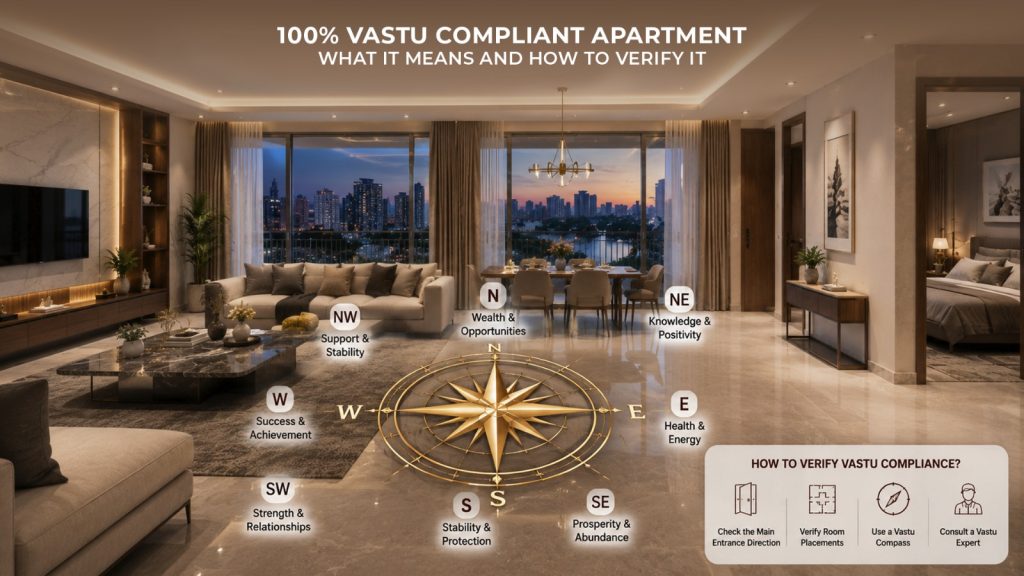
Quick answer: True Vastu compliance in an apartment means the main entrance, kitchen, master bedroom, pooja area, and living room all follow specific directional principles — not just one or two of them. Most projects marketed as “Vastu-friendly” apply this to only a subset of units or a subset of rooms. Use the room-by-room checklist below on your site visit, and ask for written certification, not verbal assurance.
Vastu Shastra remains one of the most searched — and most loosely used — terms in Bangalore real estate marketing. For many buyers, particularly those buying a long-term family home, Vastu alignment is a genuine, non-negotiable criterion. The problem is that“Vastu-friendly,” “Vastu-inspired,” and “100% Vastu compliant” are being used interchangeably in listings when they mean very different things. This checklist gives you the specific, room-level questions to ask on any site visit.
Why “Vastu-Friendly” and “100% Vastu Compliant” Are Not the Same Claim
- “Vastu-friendly” typically means the layout has made some accommodations toward Vastu principles — often just the main door direction — while other rooms may not comply at all.
- “Vastu-inspired” is looser still, often meaning the design team considered Vastu aesthetically without technical certification.
- “100% Vastu compliant” is the narrowest and strongest claim: every unit configuration, without exception, meets Vastu principles across all key rooms.
If Vastu matters to your decision, ask the sales team directly: “Is this claim based on 100% of units, or a subset?” Get the answer in writing.
The Room-by-Room Vastu Checklist
Main Entrance Direction
The entrance is considered one of the most important elements in Vastu. Ask which direction the main door faces for the specific unit you’re considering — not the tower’s general orientation, since different units within the same tower can have different entry
directions depending on layout mirroring.
Kitchen Placement
Kitchen location and the direction the cook faces while cooking are commonly evaluated Vastu factors. Ask for the kitchen’s specific placement within the unit and confirm it against the principles that matter to your family or your consulted Vastu practitioner.
Master Bedroom Orientation
The master bedroom’s location within the overall unit layout, and specifically which corner it occupies, is another frequently checked element. This varies by individual apartment layout
even within the same floor plan family (corner units vs middle units often differ).
Pooja Room / Prayer Area Placement
If a dedicated prayer space is important to you, check whether the unit has a specifically designated placement for it, and in which direction it faces.
Toilet and Bathroom Placement
Bathroom placement relative to the kitchen and main living areas is a commonly checked Vastu factor, since certain adjacencies are traditionally avoided.
Staircase and Lift Core Position (For the Tower, Not Just the Unit)
Some Vastu practitioners also evaluate the position of the central staircase/lift core relative to the building’s overall layout — a factor that’s fixed at the building design stage and cannot be altered unit-by-unit.
How to Verify a Vastu Claim Independently
- Ask for the floor plan with directional markings (North arrow) included — not just a bare layout image.
- Cross-check unit-level orientation yourself using a compass app against the plotted building direction on site.
- Ask whether the claim applies to every unit type in the project, or only specific towers/floors.
- If it matters enough, bring your own Vastu consultant to the site visit rather than relying solely on the sales team’s representation.
- Get the Vastu compliance claim in writing in the sale agreement or a formal annexure, if it was a material factor in your purchase decision.
Why This Claim Is Harder to Deliver at Scale Than It Sounds
Achieving genuine Vastu compliance across every single unit in a large, multi-tower, multi configuration project is a real design constraint — it affects core placement, unit mirroring, and floor plan variety, often at the cost of design flexibility. This is precisely why many large scale projects only achieve partial compliance: full compliance across every configuration requires the architectural planning to prioritize it from the master plan stage, not retrofit it
later.
At Tru Aquapolis, every unit across both the 3 BHK and 4 BHK configurations is certified 100% Vastu compliant — entry, kitchen, master bedroom, and living room orientation follow Vastu principles in every layout, without exception, which is a narrower and more specific claim than “Vastu-friendly” marketing common elsewhere in the corridor.
Frequently Asked Questions
Q: What’s the difference between Vastu-friendly and 100% Vastu compliant?
A: “Vastu-friendly” usually means partial accommodation — often just the entrance direction — while other rooms may not comply. “100% Vastu compliant” means every unit configuration meets Vastu principles across all key rooms, without exception.
Q: Can I verify a Vastu compliance claim myself before booking?
A: Yes. Ask for a floor plan with a North arrow, use a compass app on-site to confirm the actual unit orientation, and consider bringing your own Vastu consultant if this is a significant factor in your decision.
Q: Do all units in a Vastu-compliant project have the same orientation?
A: Not necessarily — corner units and middle units on the same floor can have different orientations even within a genuinely compliant project. Always check the specific unit you intend to buy, not the building’s general description.
Q: Is Vastu compliance a legal or regulatory requirement in Karnataka?
A: No. Vastu compliance is not a legal or RERA requirement — it’s a design choice some developers make to meet buyer preference. RERA registration and Vastu compliance are separate, independent claims and should be verified separately.