


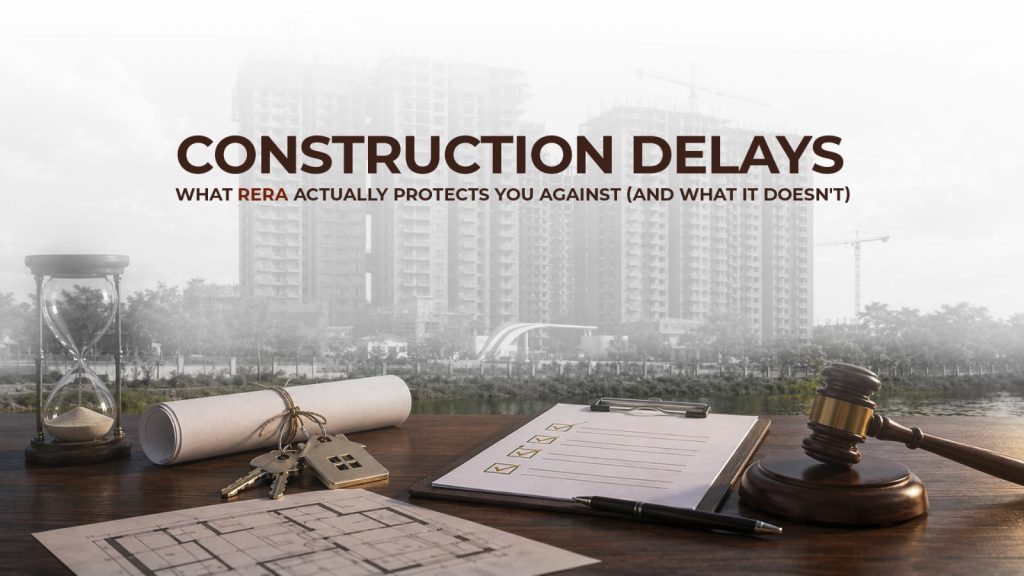
Every under-construction project carries some possibility of delay that’s true regardless of which developer you choose, and pretending otherwise would be dishonest. What actually matters is knowing what you’re entitled to if it happens, and knowing the early signs before a delay is formally announced.
The short version: if a developer misses the disclosed possession date, RERA gives you two options — withdraw and get a full refund with interest (a rate commonly set around 10% annually in RERA orders), or stay in the project and receive monthly interest compensation, often calculated as the relevant bank’s MCLR plus 2%, until possession is finally handed over. Which option makes sense depends on how far along construction actually is and how badly you need the property by a specific date.
What RERA actually promises you on delay
The Real Estate (Regulation and Development) Act, 2016 requires every registered project to disclose a possession date at the time of registration. If that date is missed without the delay falling under specific, defined exceptions (force majeure situations are treated differently), the buyer has a statutory right to compensation — this isn’t a courtesy the developer extends, it’s a legal entitlement tied to the RERA registration itself.
The compensation mechanism generally works one of two ways, and the buyer — not the developer — gets to choose:
Your two real options if possession is delayed
Option 1: Withdraw and claim a refund. You can choose to exit the project entirely and claim back everything you’ve paid, along with interest — commonly cited around 10% annually in RERA rulings, though the exact rate can vary by state notification and by the specific order. This is generally the stronger option if the delay is severe or if your confidence in eventual delivery has genuinely broken down.
Option 1: Withdraw and claim a refund. You can choose to exit the project entirely and claim back everything you’ve paid, along with interest — commonly cited around 10% annually in RERA rulings, though the exact rate can vary by state notification and by the specific order. This is generally the stronger option if the delay is severe or if your confidence in eventual delivery has genuinely broken down.
Option 2: Stay in the project and receive interest compensation. If you’d rather keep the unit than exit, RERA entitles you to monthly interest on the amount you’ve paid, calculated from the promised possession date until actual possession, often at a rate tied to the relevant bank’s Marginal Cost of Funds based Lending Rate (MCLR) plus roughly 2%. This compensation is meant to be paid automatically by the developer once a delay begins — in practice, enforcement usually still requires a RERA complaint if it isn’t paid voluntarily.
A caveat worth stating plainly: the exact interest rate applied varies by state RERA authority and by the specific circumstances of an order. Before relying on a specific percentage for your own situation, check the current rate notified by the Karnataka Real Estate Regulatory Authority directly, or get it confirmed by a lawyer handling RERA matters — don’t rely on a generic online calculator for the precise figure that would apply to your case.
How to file a RERA complaint in Karnataka
If a developer doesn’t pay the compensation automatically once a delay begins, the buyer’s recourse is a formal complaint to the Karnataka Real Estate Regulatory Authority (K-RERA), which has the power to direct the developer to pay compensation, and in more serious cases, to take other regulatory action. This is a structured, documented process — not a court case in the traditional sense — and RERA authorities were specifically created to resolve these disputes faster than a civil court would.
Red flags that predict a delay before it’s officially announced
A developer rarely announces a delay the moment it becomes likely. A few signals tend to show up earlier:
Construction updates go quiet or stop being specific. A page that used to show dated photographs and specific floor-level progress suddenly shifts to vague language (“progressing well”) without new visuals.
Payment demand timing shifts. If a construction-linked payment plan starts asking for the next instalment before the corresponding milestone is visibly complete, that’s worth questioning directly.
Site visits get discouraged or repeatedly rescheduled. A project confident in its timeline generally has no reason to make it hard for a serious buyer to see current progress.
Regulatory or land-title disputes surface. These don’t always relate directly to construction pace, but they’re strongly correlated with eventual delays, since they can freeze activity on-site while resolved.
None of these guarantee a delay is coming. They’re reasons to ask direct questions earlier rather than later.
How to track construction progress yourself
The most useful thing a buyer can do proactively is treat construction-update pages as something to check regularly, not something to glance at once before booking. Compare dated photographs against the developer’s own disclosed milestone schedule. If a milestone that was projected for a given quarter hasn’t shown up in the update page by the following quarter, that’s a fair, specific question to raise directly with the sales or project team — not an accusation, just a check.
Frequently Asked Questions
How much compensation does RERA mandate for delayed possession?
It depends on which option you choose and the specific rate notified by the state authority. Broadly: a refund with interest around 10% annually if you withdraw, or monthly interest at roughly the applicable bank MCLR plus 2% if you stay in the project. Confirm Karnataka’s current notified rate before relying on an exact figure.
Can you exit a booking if construction stalls?
Yes — RERA gives buyers the right to withdraw and claim a full refund with interest if the developer misses the disclosed possession date, regardless of how much of the amount has already been paid.
What counts as a valid reason for delay under RERA?
Force majeure events (defined narrowly — natural disasters, war, and similarly extraordinary circumstances) are treated differently from ordinary execution delays. A developer citing general market conditions or internal planning issues does not typically qualify for this exception.
The honest bottom line
RERA gives buyers real, enforceable options if construction is delayed — but exercising them requires knowing the process exists and tracking progress actively rather than assuming everything is on schedule until told otherwise. The best time to understand this framework is before you need it, not after a delay is already underway.