


No Common Wall Apartment: What It Really Means — And Why It Changes Everything About High-Rise Living
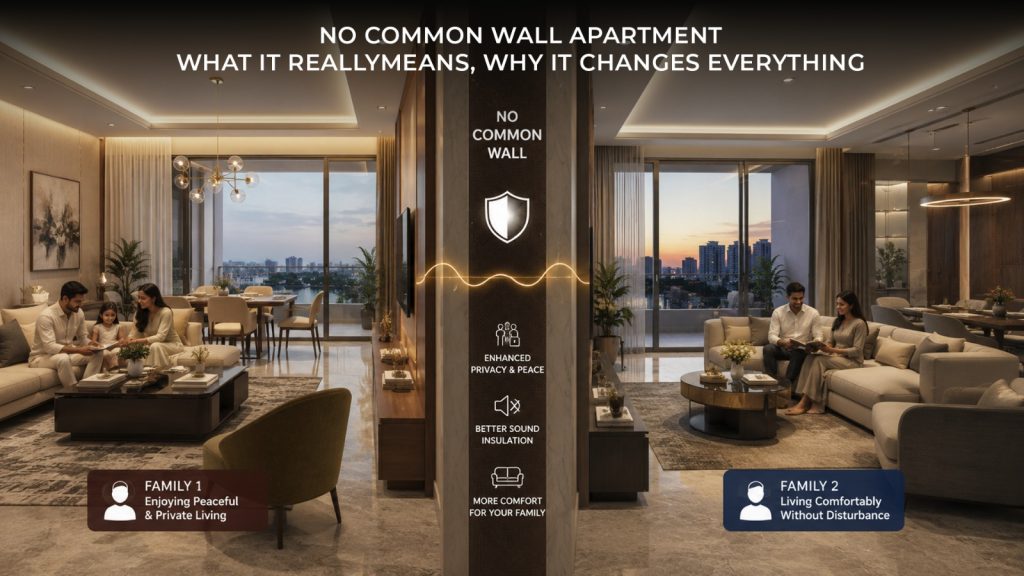
You evaluated the floor plan, the RERA number, the carpet area, the Vastu orientation. The one specification most IT professionals never check — until they move in — is the walls.
You are 38 years old, you work in product at a mid-sized tech firm, and after a 10-hour day of back-to-back Zoom calls and context switching, you want exactly one thing when you get home: quiet. The apartment was beautiful on the site visit. The floor plan was generous. The clubhouse was impressive. And then you moved in, and on your second Tuesday, at 10:45pm, you heard your neighbour’s daughter practising the violin through your master bedroom wall.
Not muffled. Clear enough to identify the scale she was practising.
This is the reality of common wall construction in high-rise apartment buildings — and it is the reality that most buyers only encounter after the booking cheque has been signed.
This guide explains exactly what a common wall is, why virtually all high-rise apartments have them, what ‘no common wall’ means structurally, and why it is one of the most practically significant specifications in residential architecture — especially for IT professionals for whom cognitive recovery after work is a daily need, not a luxury.
What Is a Common Wall in an Apartment Building?
In standard high-rise residential construction, the wall between your apartment and the apartment next door is a shared structural element. Your apartment and your neighbour’s apartment are bounded by the same physical wall — the wall belongs to both units simultaneously.
This wall is called a common wall in Indian real estate — party wall in British architectural terminology, shared wall in American usage. Regardless of the term, the function is the same: a single masonry or concrete element acts as the boundary for two adjacent living spaces.The structural reality this creates:
- Your master bedroom wall is your neighbour’s master bedroom wall
- Your kitchen wall may be your neighbour’s living room wall
- Airborne sound — conversation, television, music at moderate volume — transmits through the shared element
- Structure-borne sound — washing machine vibration, footsteps, door slams, children jumping — transmits through the structural element into your wall and floor
- Thermal transmission occurs through the shared wall — your air-conditioned apartment and your neighbour’s warmer apartment exchange heat through the common boundary
None of this is a defect. It is standard construction practice globally. The question is not whether common walls are a problem — they are the industry norm — but whether you know you have them before you commit ₹2 crore or more to live with them for the next decade.
Why Almost All High-Rise Apartments Have Common Walls
The economics of floor plate design
High-rise residential construction is fundamentally an exercise in maximising the number of units per floor while maintaining structural integrity and satisfying regulatory floor-to-ceiling heights, fire escape requirements, and parking ratios.
The simplest way to maximise units per floor is to share structural walls between adjacent apartments. Each shared wall reduces the total structural element count per floor, which:
- Reduces construction cost per unit
- Reduces the floor area consumed by walls, increasing net sellable area per floor
- Simplifies structural design and speeds construction
- Allows more apartments on each floor for the same structural footprint
For a developer building on expensive urban land in Bangalore — where development finance costs run at 14–16% annually — maximising the unit count per floor is an economic imperative. Each additional apartment per floor is meaningful revenue. Shared walls enable that density. This is why the default across virtually all Bangalore high-rise construction — and high-rise construction globally — is common wall design.
What ‘No Common Wall’ Actually Means Structurally
A no-common-wall apartment is one where no wall in your apartment shares a structural boundary with an adjacent apartment. Each apartment is bounded by its own independent structural walls — there is a physical gap or separation column between your walls and your neighbour’s walls.
This can be achieved through several architectural approaches, including structural wall independence (each apartment has its own perimeter walls separated by an air gap), column-and-beam frame designs where apartments are defined by columns rather than shared bearing walls, and floor plate configurations where shared surfaces are only with common areas like corridors and lift lobbies rather than with adjacent apartments.
The acoustic consequence is fundamental: the direct structural transmission pathway between adjacent living spaces — the pathway through which most neighbour noise travels in standard construction — is eliminated. Sound can still enter through windows, ventilation, and building-wide structural vibration, but the most impactful noise pathway in residential buildings is addressed at the architectural level.
What This Changes About Daily Life — Specifically for IT Professionals
Sleep quality and cognitive recovery
The research on sleep quality in multi-family residential buildings is consistent: noise from adjacent apartments — particularly during the 10pm–7am window — is the primary source of sleep disruption in high-rise dwellers. Sleep disruption is the primary mechanism through which poor residential acoustics impairs cognitive performance the following day.
For IT professionals whose daily work requires sustained concentration, complex problem-solving, and precise communication, sleep quality is not a lifestyle preference — it is a professional performance variable. An apartment with no common walls eliminates the most likely cause of structure-borne neighbour noise at sleeping hours.
The work-from-home dimension
Since 2020, the majority of IT professionals in Bangalore maintain some form of hybrid or full remote work schedule. A common wall apartment in a building with 200+ units means that during a Tuesday morning stand-up call, the audio environment in your designated workspace may include the structural sound of your neighbour’s conversation, their appliances, or their children’s school schedule — transmitted through a wall you cannot soundproof without structural modification.
In a no-common-wall apartment, the acoustic independence between adjacent units provides a structurally different work environment that no amount of internal noise cancellation fully replicates.
Vibration and the washing machine problem
A less-discussed but consistently reported irritant in common wall apartments is structure-borne vibration. When your neighbour runs a washing machine on a spin cycle, or has a child who enjoys jumping, or moves heavy furniture, the vibration travels through the shared structural element and into your walls and floor.
This is distinct from airborne sound and is not mitigated by soft furnishings, rugs, or conventional soundproofing. It is transmitted through the structure itself. In a no-common-wall apartment, the structural isolation between adjacent units dramatically reduces this transmission — the vibration has no direct structural pathway to enter your apartment.
Why Developers Don’t Build No-Common-Wall Apartments
If the residential experience is better, why is no-common-wall construction rare in Bangalore’s high-rise market?
The answer is direct: no-common-wall design reduces the number of apartments per floor on a given structural footprint. Independent walls per apartment consume more floor area per unit. Fewer units per floor means less revenue per floor. On Bangalore’s premium land — where development cost per sqft is substantial — this revenue reduction is real and must be offset by higher per-unit pricing.
A developer who commits to no-common-wall construction is accepting a lower total unit count in exchange for delivering a qualitatively superior residential experience per unit. Most developers in the current market cycle do not make this commitment because the market has not — until recently — consistently priced the acoustic premium.
For buyers, this means no-common-wall construction is a deliberate developer choice, not a default — and it is a choice that should be verified, not assumed.
How to Verify No-Common-Wall Claims at Any Site Visit
- Ask the sales team directly: ‘Does any wall in this specific apartment share a structural boundary with an adjacent apartment?’ A genuine no-common-wall commitment will be answered immediately and specifically.
- Ask for the structural floor plan — not the architectural floor plan. The structural plan shows columns, load-bearing walls, and structural elements. Independent wall elements at each apartment boundary confirm the claim.
- Visit the project on a weekday at peak resident hours (7pm onwards). If you can hear neighbouring apartment activity from the unit you are being shown, the no-common-wall claim may be incomplete.
- Ask specifically about all walls — not just bedroom walls. A genuine commitment covers the entire apartment perimeter relative to adjacent units.
- Ask what architectural trade-off was made to achieve this. A developer who built genuinely independent walls can explain what it cost: typically, reduced unit count per floor. If they cannot articulate the trade-off, the claim may be marketing language rather than structural fact.
What Tru Aquapolis Offers
Tru Aquapolis on Varthur Road, Whitefield is designed with no common walls between apartments across all units in all 7 towers. This is a specific structural engineering decision made at the design stage of the project — not applied retroactively or selectively.
What this means in concrete terms: in every 3 BHK (from 1,575 sqft) and 4 BHK (up to 2,590 sqft) apartment across all 24 floors in all 7 towers, no wall in the apartment shares a structural boundary with an adjacent apartment. The acoustic isolation between adjacent living spaces is fundamentally different from standard high-rise construction. To verify this during a site visit: ask to see the structural floor plan and ask the sales team to show you which walls in the specific unit you are considering are adjacent to which structural elements. Ask specifically: ‘Does any wall in this unit share a structural boundary with the apartment next to it?