


Apartments Near Varthur Lake, Whitefield: What Every IT Professional Should Know Before Buying
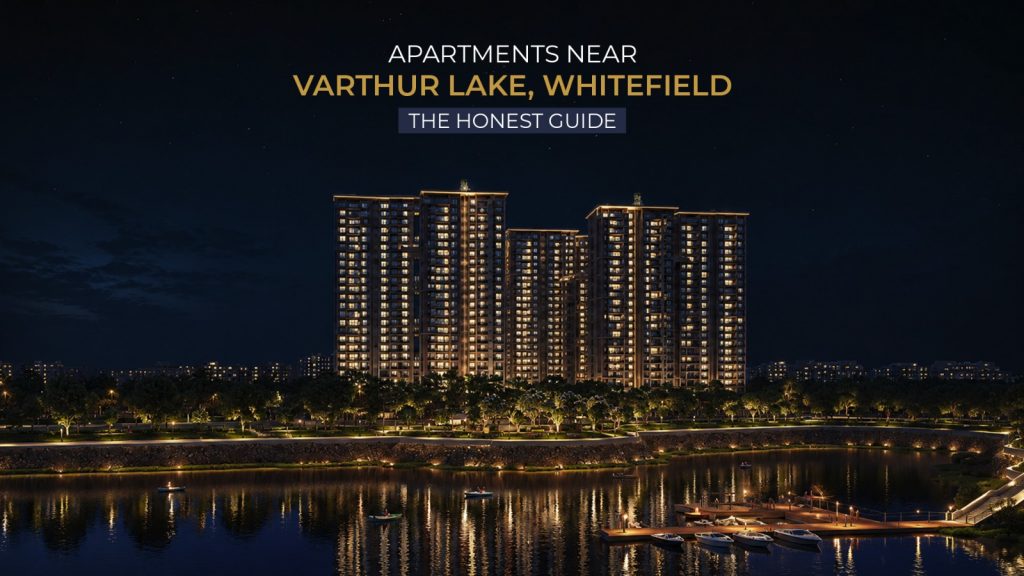
Every third project in Whitefield claims to be ‘near Varthur Lake.’ Most are marketing language. This guide explains what lake proximity actually changes — and what it doesn’t
You have been looking at apartments in the Whitefield corridor for three weekends now. You have visited projects, collected brochures, and sat through sales presentations that all promise essentially the same thing: premium living, great connectivity, and — if the project happens to be anywhere east of Whitefield Main Road — a ‘lake view’ or ‘lake-facing address.’
The problem is that ‘near Varthur Lake’ means something different on every brochure. In some cases, the lake is across the road. In others, it is 2 km away through a residential maze. In many cases, the marketing team discovered the lake existed and added it to the brochure after the floor plans were designed.
This guide gives you the precise, specific information you need to evaluate any lake proximity claim in the Whitefield–Varthur corridor — and to understand what living opposite a genuine 550-acre lake actually changes about your daily life as someone spending 8–10 hours a day at a screen in one of Whitefield’s tech parks.
What Is Varthur Lake? The Facts Worth Knowing
Varthur Lake is a freshwater lake covering approximately 550 acres in the Varthur zone of East Bangalore — the second-largest lake in the city after Bellandur Lake. For scale, 550 acres is approximately 415 standard football fields side by side. When viewed from an upper-floor apartment directly opposite, the far bank sits 1.5–2 km away on clear mornings.
The lake is fed by storm water and groundwater from a catchment area that extends into the Whitefield zone. During the monsoon months of June through September, it fills to 80–90% of its capacity. During summer months, water levels recede by 20–30%.
The lake is administered under the BBMP and the Karnataka Lake Development Authority, and has been under active restoration since 2018 — including the commissioning of sewage treatment plants upstream, installation of bio-remediation wetland zones, and regular desilting operations. The Karnataka High Court has issued multiple protection orders on Varthur Lake, creating legal infrastructure that makes further degradation both politically and legally difficult.
The honest statement on current status: the lake in 2026 is measurably cleaner than in 2015–2018 when visible froth events made national news. Restoration is ongoing and imperfect, but the trajectory is improvement. For property buyers, the relevant question is not ‘is this lake perfect?’ but ‘is this address better than an equivalent property facing a commercial road with no water body at all?’ The answer is unambiguously yes.
What ‘Near Varthur Lake’ Actually Means in Real Estate Marketing
The three categories — and why they are not equivalent
Category 1 — Directly opposite the lake: The project’s registered address is on Varthur Road, with the lake on the other side of the road. The lake edge is 100–200 metres from the tower lobby. Lake-facing units at upper floors have a direct, unobstructed line of sight across open water. This is rare. Very few projects qualify
Category 2 — Near the lake: The project is 400m to 2km from the lake margin, typically accessed via a residential lane off Varthur Road. Visual lake access depends on tower height, surrounding development, and specific unit position. Micro-climate benefit is partial at best.
Category 3 — In the Varthur area: The project is in the Varthur neighbourhood, which happens to contain a lake. ‘Near Varthur Lake’ appears in the brochure because it is geographically accurate at a very loose definition. The lake may be 2–4 km from the project.
The test is simple: ask the developer to show you the project’s registered address on Google Maps and point to the lake. If the lake is not immediately visible as the water body directly across the road from the project entrance, the claim belongs to Category 2 or 3.
What Living Opposite a 550-Acre Lake Actually Changes for an IT Professional
The micro-climate advantage — especially relevant for Bangalore summers
Large water bodies moderate the temperature of their immediate surroundings through evaporative cooling. The practical result for a property directly opposite a 550-acre lake: ambient temperatures are measurably 1–2°C lower than equivalent properties in dense commercial zones during Bangalore’s April–May peak, when temperatures have been regularly reaching 37–39°C in recent years.
For an IT professional working a standard 9–7 day, the extended outdoor comfort window matters in a specific way: the jogging track, the pool, the outdoor courts, and the evening walking areas remain usable 30–45 minutes longer per day than at equivalent properties surrounded by concrete. Over a year, that is 180+ additional hours of outdoor time. Over five years, it is a significant quality-of-life difference that no floor plan specification captures.
The air quality difference — not dramatic, but real
Particulate matter (PM2.5) concentrations near a 550-acre lake with a surrounding green buffer zone run approximately 15–25% lower than at equivalent measurement points in Whitefield’s commercial stretches during peak traffic hours. The lake’s green buffer, the absence of heavy commercial vehicle traffic on the lake-facing side, and natural wetland filtration at the water margins all contribute.
This is not the difference between clean air and polluted air — Bangalore’s air quality broadly requires improvement across the city. But it is a measurable difference that residents of lake-adjacent properties consistently report, especially during Bangalore’s dry December–February season when dust is highest.
The morning sound environment — underrated and genuinely different
Bangalore is one of the noisiest major cities in India by ambient sound measurement. The pre-dawn bird chorus from Varthur Lake’s margins — the lake hosts over 190 documented bird species — creates an acoustic environment at a direct lake-facing address that residents consistently describe as the single most unexpected quality-of-life benefit. The distinction is not between silence and noise. It is between a morning that begins with the sound of open water and 190 species of birds versus a morning that begins with the sound of a delivery truck on a commercial road.
For an IT professional who spends most waking hours managing cognitive load, the restoration function of a naturalistic morning environment is not trivial. The research on ‘soft fascination’ — the effortless attentional engagement with natural environments — shows measurable cognitive benefit for knowledge workers who have regular exposure to natural soundscapes. A lake-facing balcony is a daily access point to that benefit.
The Commute Reality From Varthur Road
ITPL — International Tech Park Bangalore, the primary employment anchor of the Whitefield IT corridor with over 80,000 employees — is 3–5 km from the Varthur Road residential stretch. On most days, this translates to:
| Time of Day | Commute to ITPL | Vs From Koramangala |
| Off-peak (before 8:30am) | 8–12 minutes | 60–75 minutes |
| Morning peak (8:30–10am) | 15–25 minutes | 75–90+ minutes |
| Evening peak (6–8pm) | 20–35 minutes | 70–90+ minutes |
The commute advantage compounds. Over a 5-year residence, the difference between a 12-minute off-peak commute and a 75-minute off-peak commute from Koramangala adds up to approximately 1,600–1,800 hours — the equivalent of 70+ full working days spent in transit. For IT professionals who value time as a constrained resource, a Varthur Road address is not just a lifestyle choice. It is a material quality-of-life and productivity decision.
What Lake Proximity Does to Property Values
The relationship between large urban water bodies and residential property values in Bangalore has a consistent track record. Properties adjacent to Ulsoor Lake, Hebbal Lake, and Sankey Tank have consistently commanded 10–18% premiums over equivalent non-lake-facing properties within the same micromarket — and that premium has widened over time as urban density increased around them.
The economic logic is structural: the lake cannot be built in front of. Its scarcity is permanent. As residential density increases on Varthur Road over the next 5–7 years — which is already underway with multiple premium launches in the current cycle — the number of lake-facing addresses relative to total residential population decreases. This supply constraint supports a premium expansion trajectory that is absent from properties facing commercial roads, where the view can always be replaced by the next building that goes up.
Varthur Lake in 2026 is at an earlier stage of this premium recognition cycle than Ulsoor or Hebbal — which represents both a current pricing discount and a future appreciation trajectory for buyers entering now.
How to Evaluate Any Varthur Road Project on Lake Proximity
Five questions to ask at any project claiming lake proximity:
1. What is your registered address, and can you show me the project on Google Maps right now? The lake should be visible as the water body directly across from the main entry.
2. Which specific towers face the lake? On a project with 7+ towers, not all face the same direction. Ask to see the master plan with compass orientation.
3. From which floor does a lake-facing unit have an unobstructed view? Compound walls and tree lines may obstruct lower floors. Ask to visit the specific floor you are considering.
4. What is the campus depth between the road boundary and the nearest residential tower? Greater depth reduces road noise significantly — relevant for the non-lake-facing side of the campus.
5. What is the land area and open space percentage per RERA? A larger campus with more open space amplifies the lake’s micro-climate benefit by creating green continuity.
Tru Aquapolis: The Specific Answer for Varthur Road
Tru Aquapolis on Varthur Road, Whitefield is positioned directly opposite Varthur Lake — the registered address is on Varthur Road, the road that runs along the lake’s eastern edge. The lake edge is approximately 100–150 metres from the tower lobby.
The campus covers 8.25 acres with 78% open space — 6.44 acres of the campus is green, landscaped, and walkable. Seven towers at 24 floors each provide the elevation to have unobstructed lake views from upper-floor lake-facing units. The project is designed with no common walls between apartments and 100% Vastu compliance across all configurations.
3 BHK apartments start from 1,575 sqft. 4 BHK apartments extend to 2,590 sqft. Site visits are available 7 days a week, 10am–6pm — commitment-free. [Schedule a site visit]
RERA: PRM/KA/RERA/1251/446/PR/040625/007808 | Verify at rera.karnataka.gov.in
3 BHK from 1,575 sqft · 4 BHK up to 2,590 sqft · Varthur Road, Whitefield, Bengaluru 560066