


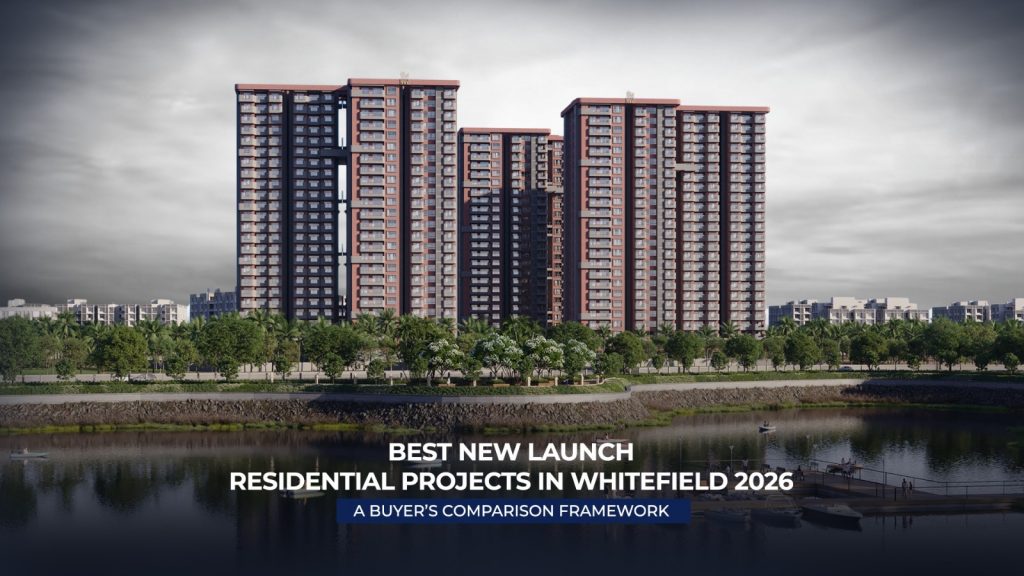
Quick answer: There is no single “best” new launch in Whitefield in 2026 — there’s only the project that scores highest against your priorities. The seven criteria that actually separate a strong new launch from an average one are: open space ratio, units-per-acre density, Vastu compliance (certified vs “friendly”), wall-sharing structure, clubhouse area per resident, RERA registration status, and true price-per-sqft after add-ons. This guide gives you the
exact numbers to ask for on every site visit.
Whitefield in 2026 has more active new launches than at any point in the last five years — Varthur Road, ECC Road, Hope Farm, and the ORR-facing pockets are all seeing fresh inventory hit the market simultaneously. That’s good for buyers in theory. In practice, it means marketing brochures have gotten louder and vaguer at the same time. Almost every project now claims to be “premium,” “low-density,” and “close to the lake.” Those words are
not comparable data points. This guide replaces them with seven measurable criteria you can apply to any project you’re evaluating — including this one.
Why “Best” Is the Wrong Question to Start With
Ranking projects on a 1-10 scale assumes every buyer wants the same thing. An IT professional buying a 3 BHK for self-use in 2026 has different priorities than an investor targeting rental yield by 2028. Before comparing projects, decide which of these you’re
actually optimizing for:
- Livability — density, noise insulation, Vastu, layout efficiency
- Appreciation potential — land parcel size, developer track record, infra triggers nearby
- Possession timeline — pre-launch vs near-completion vs ready
- Total cost of ownership — price/sqft plus maintenance, plus loading factor
Once you know which lens matters most, the seven criteria below become a scorecard rather than a marketing comparison.
The 7-Point Comparison Framework
Open Space Ratio (Not Just “Green Cover”)
Ask for the exact percentage of the total land parcel left as open space — not landscaped strips between towers. Anything above 70% on an urban Whitefield parcel is genuinely rare; most dense high-rise developments in the corridor run between 45-60%.
Tru Aquapolis sits at 78% open space across its 8.25-acre parcel — you can verify this against the sanctioned plan filed with K-RERA, not just the brochure.
Units Per Acre (True Density)
Divide total units by total acreage. A 20+ acre township with 2,000+ units and a 3-acre plot with 300 units can both call themselves “spacious” — the math tells a different story. Lower
units-per-acre generally means less lift-wait time, less parking pressure, and quieter common areas.
Vastu — Certified vs “Friendly”
“Vastu-friendly” and “Vastu-inspired” are marketing phrases with no fixed technical meaning. Ask specifically: is every unit configuration — entry direction, kitchen placement, master bedroom orientation — certified compliant, or only a subset of units? Tru Aquapolis apartments are 100% Vastu compliant across all layouts, which is a narrower and more verifiable claim than “Vastu-friendly.”
Wall-Sharing Structure
In most high-rise apartment construction, adjacent units share structural walls — standard practice, and not a defect. But if acoustic privacy and structural independence matter to you, ask directly whether any wall of your unit is shared with a neighboring apartment. Zero shared-wall design at high-rise scale i uncommon; Tru Aquapolis’s no-common-wall structure is one of the few in the corridor built this way.
Clubhouse Area Per Resident
A 15,000 sq ft clubhouse serving 3,000 units delivers a very different daily experience than a 70,000 sq ft dual clubhouse serving under 1,000 units. Ask for total clubhouse sq ft divided by total unit count — this single ratio tells you more about actual amenity access than the amenity count itself.
RERA Registration Status
Every genuine new launch in Karnataka must carry a K-RERA number before marketing or collecting payment. Cross-check the number directly on rera.karnataka.gov.in — not on the builder’s website — for approved layout, promised possession date, and any regulatory flags. See our RERA verification checklist for the full process.
Price Per Sq Ft
“Starting from ₹X” pricing usually reflects the smallest unit on the highest floor with the least desirable facing. Ask for the price/sqft on the specific unit and floor you want, inclusive of floor rise, PLC (preferential location charges), car parking, and clubhouse membership — not the base rate alone.
A Sample Scorecard
| Criteria | What to Ask For | Why It Matters |
| Open space % | Sanctioned plan copy | Determines density feel, ventilation, green cover |
| Units/acre | Total units ÷ acreage | Predicts lift wait, parking, noise |
| Vastu scope | % of units certified | Verifies real vs marketing claim |
| Wall sharing | Structural drawing | Impacts privacy, acoustics |
| Clubhouse sqft/unit | Total clubhouse ÷ units | Predicts real amenity access |
| RERA status | K-RERA portal number | Legal safety, possession accountability |
| True price/sqft | Full cost breakup | Prevents under-quoted comparisons |
Where This Leaves You
None of these seven criteria require taking a brochure’s word for it — every one of them is independently verifiable on a site visit or on the K-RERA portal. That’s the point: a genuinely strong new launch should hold up when you ask for the underlying numbers, not just the adjectives.
Tru Aquapolis publishes its open space ratio (78%), density (7 towers on 8.25 acres), Vastu scope (100%), and RERA number
(PRM/KA/RERA/1251/446/PR/040625/007808) precisely because these hold up to scrutiny.
Frequently Asked Questions
Q: How do I know if a new launch project in Whitefield is genuinely low-density?
A: Calculate units per acre using the total sanctioned unit count and land parcel size from the RERA filing, not marketing copy. Divide clubhouse and open space area by total units for a
per-resident figure — that’s a more honest measure than “spacious” or “premium” labels.
Q: Is a higher number of amenities always better?
A: Not necessarily. A project listing 150+ amenities across a small parcel serving thousands of units often means heavy shared
use and scheduling pressure. Amenity area per resident is a better indicator than the raw amenity count.
Q: What’s the difference between “Vastu-friendly” and “100% Vastu compliant”?
A: “Vastu-friendly” has no standard technical definition and can apply to just a few units in a project. “100% Vastu compliant” means every unit configuration — not a subset — meets certified Vastu principles for entry, kitchen, and bedroom placement.
Q: Where can I verify RERA registration for a new launch in Whitefield?
A: Search the project name or RERA number directly on rera.karnataka.gov.in. This shows the sanctioned layout, promised possession date, and any regulatory updates — independent of what the builder’s own website states.
Related reading:
Understanding RERA in Karnataka · Why Invest in Whitefield ·
Aquapolis Project Overview